---
title: "AI Website Readiness Checklist (2026): How to Rank in AI Search"
url: "https://www.krishaweb.com/blog/ai-website-readiness-checklist/"
date: "2026-01-30T13:31:24+00:00"
modified: "2026-06-18T11:35:46+00:00"
author:
name: "Nisarg"
categories:
- "Web Design"
word_count: 1226
reading_time: "7 min read"
summary: "In 2026, your website will no longer compete only in Google’s blue links."
description: "A complete 2026 AI website readiness checklist to help your site rank in AI search, Google AI Overviews, ChatGPT & Perplexity. Audit, fix, grow."
keywords: "AI Website Readiness, Web Design"
language: "en"
schema_type: "Article"
related_posts:
- title: "AI in Web Design and Development: What Actually Changed"
url: "https://www.krishaweb.com/blog/ai-website-design-development/"
- title: "Website UX Best Practices: AI-Driven Optimization"
url: "https://www.krishaweb.com/blog/website-ux-design-best-practices/"
- title: "Web Design Services: What’s Included, What It Costs, and How to Choose"
url: "https://www.krishaweb.com/blog/web-design-services/"
---
# AI Website Readiness Checklist (2026): How to Rank in AI Search
_Published: Friday,January 30, 2026_
_Author: Nisarg_
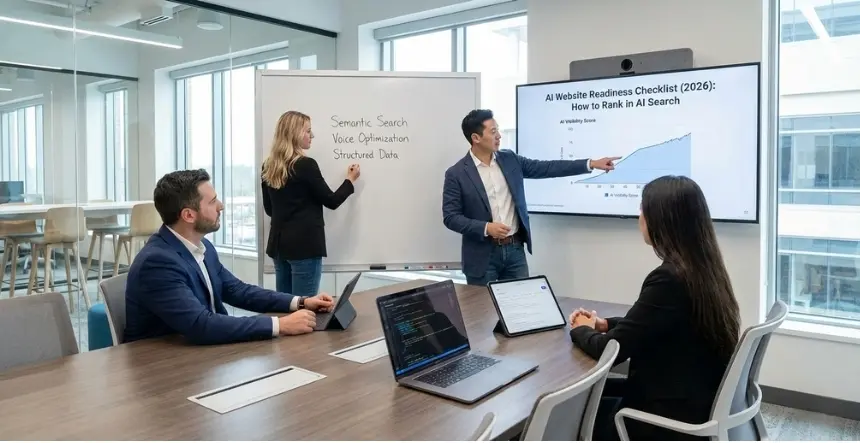
In 2026, your website will no longer compete only in Google’s blue links.
It’s competing to be **chosen, summarised, and cited by AI**.
Today, nearly **68% of commercial searches are answered by AI systems**—Google AI Overviews, ChatGPT, Perplexity, and similar tools. And here’s the uncomfortable truth: most businesses are discovering too late:
If your website isn’t structured for AI understanding, it simply doesn’t exist in revenue-driving answers.
Not “ranking lower.”
Not “page two.”
**Invisible.**
Even strong SEO sites are losing up to **73% of potential AI traffic** because they lack entity trust, structured clarity, and answer-first content.
This guide is designed to help you **fix that step by step**.
No hype. No jargon. Just a practical checklist you can actually use to:
- Audit your current AI readiness
- Prioritise what matters most
- Build visibility inside AI answers (not just search results)
## Why AI Readiness Matters *Now* (The 2026 Reality)
Search behaviour has quietly crossed a tipping point.
Here’s what’s changed:
- **AI intercepts up to 68% of queries before users ever click Google**
- **Zero-click answers now cite only 3–5 sources** per question
- AI ranks **entities and trust**, not just pages and keywords
- Traditional SEO without AEO (Answer Engine Optimisation) sees **87% fewer AI mentions**
**In other words, AI doesn’t ask:**
*“Which page has the most backlinks?”*
**It asks:**
*“Which business can I trust to answer this correctly?”*
**That shift changes everything**—from how content is written to how websites are structured.
## The 10-Step AI Readiness Checklist (Score Your Site Honestly)
Use this as a diagnostic, not a judgment. Most sites score lower than expected—and that’s normal.
### 1. Entity Trust Foundation
AI doesn’t cite *pages*. It cites **verifiable businesses**.
**Ask yourself:** *Can AI clearly understand who we are, where we exist, and why we’re credible?*
**Your site should clearly establish:**
✅ Consistent business name, address, and phone details across major directories
✅ A real **About page** with company history, leadership, and location
✅ Third-party validation (press, directories, trusted mentions)
✅ Clean, error-free **Organisation schema**
✅ Public signals that confirm legitimacy (reviews, profiles, citations)
**Quick reality check:
Search *“best [your service] in [your city]”* inside ChatGPT or Perplexity.
If your business doesn’t appear at all, your entity trust is weak.
### 2. Answer-First Content Structure
AI extracts answers fast—often from the **first 60–90 words**.
That means your content must **answer before it explains**.
Strong AI-ready pages:
✅ Lead with a direct answer in the opening paragraph
✅ Use H1s that match real user questions
✅ Follow with H2s that mirror natural follow-ups
✅ Include tables for comparisons and summaries
✅ Use the FAQ schema on service and decision pages
**Simple fix:
Rewrite your top 5 pages so the first paragraph clearly answers:
Who is this for? What problem is solved? How does it work?
### 3. Technical Crawlability
Many businesses lose AI visibility for one boring reason:
**AI can’t reliably read their site.**
**Here are some common reasons for blocking the AI:**
✅ JavaScript-heavy rendering with missing server-side content
✅ Disallowed AI crawlers
✅ Poor performance metrics
**You should use the following as your technical baseline:**
✅ Crawling of the following bots should be allowed in robots.txt: GPTBot, Google Extended, and ClaudeBot.
✅ Text should be in raw HTML (not only loaded via JavaScript)
✅ Sites should load quickly (LCP should be under 2 seconds).
✅ No accidental noindex tags
✅ Clean, updated XML sitemaps
If an AI cannot crawl your website, it cannot cite it.
### 4. Schema & Structured Data Mastery
Schema does not directly help with ranking, but it helps AI understand your content as well.
Websites that properly use structured data are cited approximately **3x times more than websites** that do not.
**Your website should use at least the following schema:**
✅ Organisation and LocalBusiness schema
✅ A schema to indicate the services provided in the areas served.
✅ Schema to indicate FAQ pages and How To pages as appropriate.
✅ Schema to create article + author markup for blogs.
✅ Schema to create breadcrumb navigation.
A schema is a way of labelling content for the AI and not programming content for developers.
### 5. Topical Authority Clusters
AI prefers depth versus breadth of content.
**Therefore, AI prefers:**
✅ One **pillar page** for each of the core service categories that exceeds 3,000 words in length.
✅ Many supporting articles related to sub-topics for each pillar.
✅ Clear internal linking between the pillar and supporting articles to reinforce topic relationships.
✅ Author attribution and source citations.
Building this structure demonstrates expertise- not just activity.
### 6. Conversational Intent Coverage
AI queries sound like conversations, not keywords.
When creating content, use subheadings containing questions, and your copy should answer questions such as:
- “How much does this cost?”
- “Is this right for my business?”
- “Why choose this over alternatives?”
**Best practices:**
✅ Use question-based subheadings
✅ Keep your answers short and direct (40 to 60 words each)
✅ Use a natural speaking tone when writing
✅ Have a clear table of contents for long pages
### 7. Performance & User Experience
Speed is still of utmost importance, especially on mobile devices.
**The bare minimum requirement would be:**
✅ Mobile Lighthouse scores above 90 or better
✅ Fast server response times
✅ Optimised images (WebP)
✅ Non-layout shifting
✅ Minimal redirects
**Content that users don’t abandon is favoured by AI.**
### 8. Monitoring & Measurement
If you can’t monitor it, you can’t optimise it.
**You will require the following types of monitoring to make your content AI-ready:**
✅ GA4 referral tracking from AI tools
✅ Google Search Console’s AI overview impressions report
✅ Schema validation checks
✅ Competitor citation monitoring
Without these requirements, you will have to rely on guesswork when attempting to itemise your content for optimisation via AI.
##### Additional Read
- [SEO Is Not Enough Anymore: How AI Search Changed Website Discovery](https://www.krishaweb.com/blog/seo-not-enough-ai-search-optimisation/)
- [Why Most Business Websites Fail to Generate Leads in the AI Era](https://www.krishaweb.com/blog/why-business-websites-fail-leads-ai-era/)
- [How AI Is Changing Client Expectations in Web Development – 2025 Survey Findings](https://www.krishaweb.com/blog/ai-client-expectations-web-development-survey-findings/)
## Your AI Readiness Score — What It Means
| **Score range** | **Status** | **Action to take** |
|---|---|---|
| 0–40 | Critical | Fix entity and technical issues immediately. |
| 41–65 | Urgent | Add Schema and Prioritise Answer-based Content. |
| 66–85 | Strong | Invest in creating content clusters and regularly updating established content. |
| 86+ | Excellent | Monitor and grow. |
A score below 65 can have dire consequences, including the loss of AI-driven demand.
## A Realistic 90-Day AI Optimisation Timeline
**Weeks 1–2:**
- Entity cleanup, schema fixes, crawl access
**Weeks 3–6:**
- Rewrite top pages for answer-first clarity
- Deploy FAQ and service schema
**Weeks 7–10:**
- Launch pillar pages and supporting content
**Month 3:**
- Track AI mentions, refine, and expand
*This isn’t theory. It’s how AI visibility compounds.*
### Final Thought: Your Website Is Either Training AI—or Being Ignored by It
AI isn’t the future of search.
It’s the present filter between your business and demand.
In 2026, winning websites will be those that have a clearer message and provide more trustworthy content than their competitors or those perceived as superior.
At KrishaWeb, we have assisted many websites in transitioning from traditional SEO to readiness for AI, enabling them to achieve measurable visibility and growth rather than just vanity rankings.
If you want to understand how your website stacks up against competitors — and what needs to be fixed first — you can request an **[AI Readiness Audit](https://www.krishaweb.com/ai-readiness-assessment/)** or [**contact KrishaWeb**](https://www.krishaweb.com/contact-us/) for a strategic review.
With the way AI search works today, visibility is no longer something you earn later through media placements. It’s something you [**design for now**](https://www.krishaweb.com/web-design/) — so your website stays discoverable, trusted, and competitive in the future.
### Frequently Asked Questions
**What is AEO?**Answer Engine Optimisation focuses on helping AI extract and cite your content—not just rank it.
**Does schema really matter?**Yes. It dramatically improves AI understanding and citation accuracy.
**How long before results appear?**Technical improvements show quickly. Citations usually follow within 1–3 months.
**Is this only for big brands?**No. Local and midsize businesses often win faster because of clearer entity signals.
###### Nisarg Pandya
Project ManagerExperienced Project Manager and Scrum Master at KrishaWeb, delivers expertise in Scrum methodologies, Laravel, React.js, UX design, and project management, ensuring efficient project delivery and agile implementation.
 Interact With Me-
-
- [ ](mailto:)
---
_View the original post at: [https://www.krishaweb.com/blog/ai-website-readiness-checklist/](https://www.krishaweb.com/blog/ai-website-readiness-checklist/)_
_Served as markdown by [Third Audience](https://github.com/third-audience) v3.5.3_
_Generated: 2026-06-18 11:35:46 UTC_