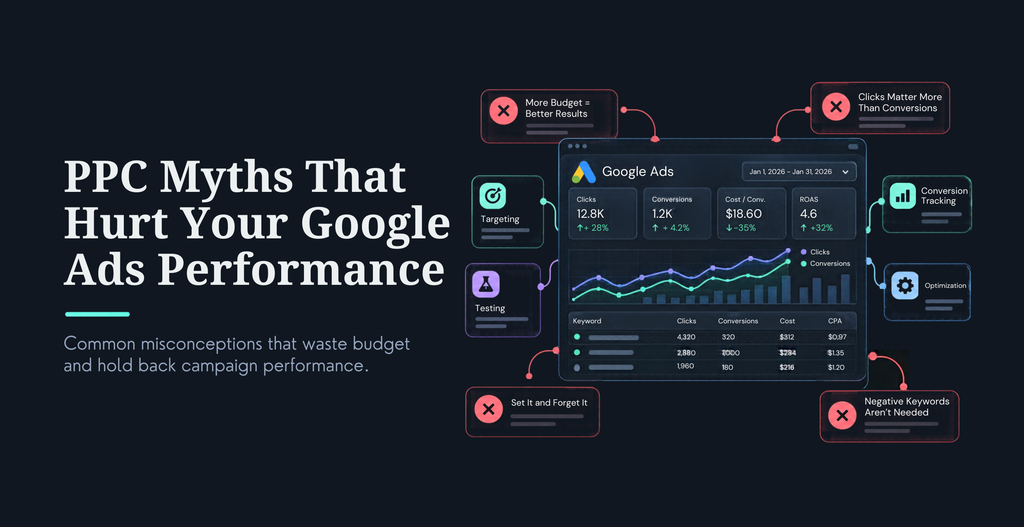
The PPC myths that cost advertisers the most are these five: a higher bid guarantees better results, the top ad spot always converts best, keywords with no direct conversions should be paused, PPC is a quick test you can judge in a month, and Smart Bidding runs your account for you. Every one sounds sensible. Every one quietly drains budget.
Most PPC budget is not lost on bad ads. It is lost on decent ads run on old assumptions. In my experience, the fix is rarely more spend. It is cleaner conversion data, targets built on real numbers, and a better question than “where do we rank?”
We first wrote this post in 2015. Google Ads has changed almost completely since. Average position is gone. Bidding is mostly automated. Ads now appear inside AI answers. So this version rebuilds every myth for how Google Ads works today.
PPC myths at a glance
Myth
Reality
Smart Bidding runs your Google Ads account by itself
It automates bids. It still depends on your conversion tracking, values, targets, and budget.
A higher bid guarantees better results
A higher bid improves auction strength only. Quality and relevance decide what you win and what you pay.
The top position always means more conversions
Top placement raises visibility. It does not guarantee a better CPA or ROAS, so test it keyword by keyword.
Pause any keyword with no direct conversions
Some keywords start journeys that other keywords finish. Check assisted value before you cut.
You can judge PPC after one month
A month is the minimum reading window for Smart Bidding. Profitability takes longer.
Can Smart Bidding run your Google Ads account by itself?
No. Smart Bidding automates bids in every auction, but it still depends on you for accurate conversion tracking, meaningful conversion values, realistic targets, and a workable budget.
Here is how Google describes it. Smart Bidding uses Google AI to optimize for conversions or conversion value in every auction. Target CPA, Target ROAS, Maximize conversions, and Maximize conversion value all count as Smart Bidding strategies. The tools I criticized in 2015, Enhanced CPC and the old Conversion Optimizer, were early versions of this idea. Today’s systems are far better. But they are only as good as the signals you feed them.
Take a lead generation account that counts every form fill, phone tap, and newsletter signup as one equal conversion. The algorithm hunts for the cheapest signups, because that is what you asked for. Sales calls drop. The dashboard looks great. The fix is to assign values. A booked consultation counts for more than a downloaded checklist. Then bid toward value, not volume.
Google also sets clear expectations on data. It recommends judging Smart Bidding over a month or longer with at least 30 conversions, and 50 for Target ROAS. Low-volume campaigns need patience, or fewer and broader campaigns, so the system has enough data to learn from.
2026 added a new wrinkle. In June, Google relabeled “Maximize conversions with a Target CPA” as Target CPA and “Maximize conversion value with a Target ROAS” as Target ROAS, with no change in behavior, as its developer blog explains. Google also announced, in its Google Ads Help bidding documentation, that from August 17, budget-limited Target CPA and Target ROAS campaigns that had been beating their targets are steered closer to them. Say you set a $50 target a year ago and the campaign has been landing at $35. Expect delivery to drift toward $50. Check that this is what you want.
I use a simple routine I call the Signal-First method. Fix the signal before you touch the bid.
Assign real values to each action, even rough ones.
Set targets from the last 30 to 90 days of actual performance, not from hope.
Hold changes through a full learning window, then review.
Read the search terms report every week. Automation can widen reach faster than you expect.
Does bidding more guarantee better Google Ads results?
No. A higher bid can improve your Ad Rank, but it does not guarantee a better position, more conversions, or more profit.
Ad Rank combines your bid with expected click-through rate, ad relevance, landing page experience, and the context of the search. Say two advertisers chase the same keyword. One bids $4 with a vague ad and a slow page. The other bids $2.50 with a tight ad and a fast, relevant page. The second can win the better spot and pay less per click. That was true in 2015. It is truer now.
The goal I gave clients in 2015 still holds: win the spot you need without paying extra for it. In practice, that means improving quality first. Group keywords by one intent. Write ads that match the search. Fix page speed and message match. Then raise bids only where the data shows a profitable return. For the bigger picture, see our guide to full-funnel PPC campaign optimization.
With Smart Bidding you rarely set keyword bids at all. You set a target instead. Raising a Target CPA raises what the system is willing to pay, and it raises your cost per lead too if nothing else improves. Treat a higher target as a decision with a price tag, not a shortcut.
Does the top ad position always generate more conversions?
No. Top placement raises visibility, but visibility and conversions are different things. The top spot often costs more per click, and the extra clicks are not always better ones.
My 2015 advice told you to chart average position against conversions. That advice is now impossible to follow. Google announced in February 2019 that it was removing the average position metric and replacing it with top and absolute top impression metrics. Average position had long been a blurry measure of rank, not real placement, so the change made sense.
Use these instead. Search top impression rate shows how often your ads appeared above the organic results. Search absolute top impression rate shows how often you were the very first result. Pair them with impression share, lost impression share to rank and to budget, and most important, CPA and conversion rate by segment.
Here is a split worth testing. Bid hard for absolute top on your brand terms, where clicks are cheap and competitors may be bidding on your name. Be more relaxed on broad, high-cost generic terms. A lower position on those terms can bring a lower CPA, because the click costs less. Test it instead of assuming.
Should you pause keywords that don’t show direct conversions?
Not necessarily. A keyword with no last-click conversions may still start the journey that another keyword finishes. Check its assisted role before you cut it.
Picture a buyer who searches “best project management software” on Monday and clicks your ad. She leaves. On Friday she searches your brand name, clicks, and requests a demo. Under last-click credit, the brand keyword gets everything. Pause the Monday keyword and you may starve the Friday one.
Attribution has changed since I first wrote about this. Google Ads now defaults to data-driven attribution, which spreads credit across the ads that helped. Last click is still available. The older rule-based models, such as first click, linear, time decay, and position-based, have been retired. Data-driven attribution credits early clicks better. But it needs conversion volume, and it only sees the touchpoints Google can measure.
Before you pause a keyword, check these:
Did it get enough clicks to judge? Compare its spend with your target CPA.
Does it appear in conversion paths or assisted conversions?
Are the search terms behind it relevant, or is it matching junk?
Does the landing page match the intent of the search?
Is the match type too broad for what you sell?
If the terms are irrelevant, add negatives. If the keyword has had plenty of clicks, spent several times your target CPA, and shows no assist value, pause it. That is a data decision, not a reflex.
Is PPC only useful for short-term results?
No. PPC can send traffic on day one, but it builds value over months. Judge it after a few weeks and you will measure the learning period, not the channel.
Traffic speed is not learning speed. As noted above, Google recommends reading Smart Bidding results over a month or longer, with at least 30 conversions. Low-volume accounts need more time. In the early weeks you are still gathering data, testing ads, and cleaning up search terms.
What compounds? Negative keyword lists get sharper. Ad tests find what wins. Audience signals improve. Landing pages get fixed. Each month starts from a better place than the last. Teams that quit at week four never collect any of it.
I also see teams copy competitor keywords and ads and expect the same results. It rarely works. Your competitor has different margins, a different offer, and a different site. Use their ads as a prompt, then build around what only you can promise.
Paid search and organic also feed each other. PPC shows you which queries convert fast. You can then build content for those queries and lower your cost over time. That is how we think about SEO and paid search working together.
How is AI search changing PPC?
AI search is adding new ad placements and new campaign options. It is not making paid search obsolete. It is making clean data, strong landing pages, and search term control matter even more.
The biggest change is AI Max for Search. Google announced that campaigns using Dynamic Search Ads, automatically created assets, or the campaign-level broad match setting would be upgraded to AI Max starting in September 2026. Google also reports that AI Max campaigns see an average of 7% more conversions or conversion value at a similar CPA or ROAS when using the full feature suite, compared with search term matching alone.
Ads are also showing up inside Google’s AI answers. Google has said that Search campaigns using broad match, Performance Max, and Shopping can be eligible for ads in AI Overviews and AI Mode, and that eligibility keeps expanding. Check Google Ads Help for the current rules, because they have shifted more than once this year. If your account runs only exact and phrase match, review whether you are missing these placements.
What should you do about it? Watch the search terms report closely, because broader matching can pull in loose queries. Add negatives early. Make landing pages specific, since queries in AI search tend to be longer and more conversational. Keep conversion tracking tight. And pair paid with organic. AI tools cite pages they can parse easily, which is where AEO and GEO optimization pays off.
One new myth to watch: that AI Max means you can stop managing keywords and search terms. It widens reach. It does not review your queries for you.
What should you focus on instead of these PPC myths?
Focus on business outcomes first, then the metrics that explain them. Conversion quality, CPA, ROAS, conversion value, search term relevance, and landing page performance tell you far more than position or bid size.
Metric
What it tells you
Common mistake
Conversion quality
Whether conversions become qualified leads or sales
Counting every form fill equally
CPA
What it costs to win one conversion
Comparing CPA across conversions of different value
ROAS
Revenue returned per dollar of ad spend
Ignoring margin
Conversion value
Which conversions matter most
Leaving every value at the same number
Search term relevance
Whether you pay for the right intent
Never opening the search terms report
Top and absolute top impression share
How often you win prominent placement
Chasing 100% on every keyword
Landing page conversion rate
Whether clicks turn into action
Blaming bids for a page problem
If I had to pick one habit, it is this. Review the account against business results every month, not just platform metrics. A campaign can hit its target ROAS and still lose money when margins are thin. Platform numbers describe the ads. Your profit and loss statement describes the business.
Frequently Asked Question
Does a higher Google Ads position mean more conversions?
Not always. A higher position raises visibility and usually raises cost per click, but conversions depend on search intent, ad relevance, and the landing page. Test top placement by keyword. Brand terms often justify absolute top. Broad generic terms often convert at a lower CPA a little further down. Track CPA and conversion rate by segment, not average position, which Google retired in 2019.
Is PPC only useful for short-term results?
No. PPC can bring traffic quickly, but results improve as you collect data, refine search terms, test ads, and fix landing pages. Google recommends reading Smart Bidding performance over a month or longer with at least 30 conversions. Teams that judge PPC after two weeks are usually measuring the learning period, not the channel.
Can Smart Bidding manage Google Ads automatically?
It manages bids automatically, but not the whole account. Smart Bidding needs accurate conversion tracking, meaningful conversion values, realistic Target CPA or Target ROAS goals, and enough conversion volume. Google puts that at 30 or more conversions over a month or longer. You still need to review search terms, ad quality, budgets, and landing pages.
Should I pause a keyword with no conversions?
Not before you check its role. Look at conversion paths or assisted conversions, search term relevance, spend compared with your target CPA, and landing page fit. If the keyword has had plenty of clicks, spent several times your target CPA, and shows no assist value, pause it. If the search terms are irrelevant, add negative keywords instead.
What replaced average position in Google Ads?
Google retired average position in 2019 and replaced it with search top impression rate and search absolute top impression rate, plus top and absolute top impression share. Top shows how often your ad appears above the organic results. Absolute top shows how often your ad is the very first result on the page.
Do Google Ads appear in AI Overviews and AI Mode?
In some cases, yes. Google has said eligible campaigns include Performance Max, Shopping, and Search campaigns using broad match or AI Max. Eligibility has been expanding, so check Google Ads Help for the current rules in your account and market. Review search terms and landing pages, because these placements can match broader, more conversational queries.
Ready to Scale Your Agency?
Tell us what you are trying to deliver. Schedule a call to talk it through, or contact us with your project.
Founder & CEO of KrishaWeb, leads an Enterprise Web Agency. With contributions to WordPress and organization of WordCamps, he pioneers innovation and community engagement in the digital realm.




 KrishaLabs
 KrishaStudio
 KrishaStore