---
title: "The Cost of Integrating AI in 2026: Build, Run, and Total Cost of Ownership"
url: "https://www.krishaweb.com/blog/cost-of-integrating-ai/"
date: "2026-07-31T13:01:39+00:00"
modified: "2026-08-06T10:33:04+00:00"
type: "Article"
resource: "https://www.krishaweb.com/blog/cost-of-integrating-ai/"
timestamp: "2026-08-06T10:33:04+00:00"
author:
name: "Parth"
url: "https://www.krishaweb.com/"
categories:
- "Web Development"
word_count: 1995
reading_time: "10 min read"
summary: "Integrating AI into your business in 2026 costs $15,000 to $250,000 to build, plus $500 to $50,000 or more per month to run, plus 15 to 25% of the build cost every year to maintain. That third numb..."
description: "What AI integration really costs in 2026: build cost, monthly run cost, 3-5 year total cost of ownership, platform benchmarks, and the cost of failure."
keywords: "cost of integrating AI, Web Development"
language: "en"
schema_type: "Article"
related_posts:
- title: "How USA Manufacturers Choose Digital Transformation Partners"
url: "https://www.krishaweb.com/blog/manufacturing-digital-transformation-partner/"
- title: "AI Chatbots for US eCommerce: Cost, Compliance, and ROI in 2026"
url: "https://www.krishaweb.com/blog/ai-chatbot-us-ecommerce-cost-roi/"
- title: "White Label Web Development for Small Agencies: How to Scale Without Hiring"
url: "https://www.krishaweb.com/blog/white-label-web-development-small-agency/"
---
# The Cost of Integrating AI in 2026: Build, Run, and Total Cost of Ownership
_Published: Friday,July 31, 2026_
_Author: Parth_
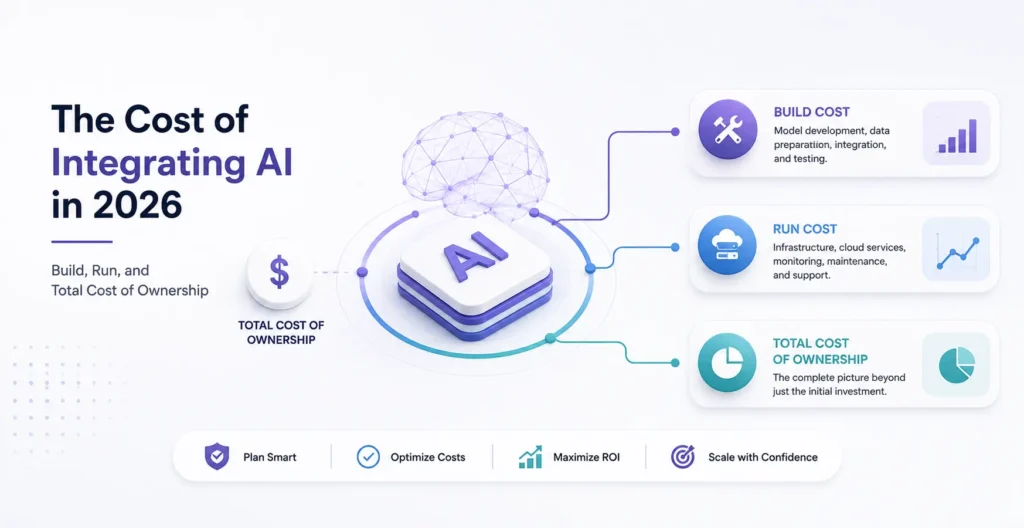
Integrating AI into your business in 2026 costs $15,000 to $250,000 to build, plus $500 to $50,000 or more per month to run, plus 15 to 25% of the build cost every year to maintain. That third number is the one almost every cost guide leaves out, and it is the one that decides whether your AI project is a smart investment or a slow budget leak.
Most articles on this topic stop at the build price. But enterprise buyers do not think in project cost, they think in total cost of ownership over three to five years. So this guide covers all three dimensions, then goes where the other guides do not: real cost benchmarks by industry, a side-by-side platform pricing comparison, and the cost of the thing nobody wants to talk about, AI projects that fail.
If you want the deep enterprise-integration version of this, we cover it separately in the[ **cost of integrating AI into existing enterprise systems**](https://www.krishaweb.com/blog/cost-of-integrating-ai-into-enterprise-systems/). This piece is the complete cost picture for any business weighing the investment.
## The three dimensions of AI cost (not one)
The single biggest mistake in budgeting AI is treating it as a one-time build. It is three costs, not one, and you have to plan for all three.
**Build cost** is what it takes to design, develop, and integrate the AI: $15,000 to $250,000 depending on scope. This is the number everyone quotes.
**Run cost** is what it costs every month once it is live: $500 to $50,000+ per month, driven mostly by model usage (token consumption), cloud compute, and infrastructure. The catch that surprises teams: run cost scales with adoption, so the more successful your AI is, the more it costs to operate.
**Ownership cost** is the ongoing maintenance most people forget: 15 to 25% of the build cost per year for monitoring, retraining as the model drifts, security audits, and iteration. Research shows 81% of organizations fail to budget adequately for this, which is why so many AI projects quietly overspend in year two.
Add these across three years, and you get the number that actually matters. A $100,000 build is not a $100,000 project. With run and maintenance, its three-year total cost of ownership can be double or triple the build price. That is the figure to take to your CFO, not the sticker.
## AI integration cost breakdown by category
Here is where the money actually goes, with real 2026 ranges.
| **Cost category** | **Typical range** | **Notes** |
|---|---|---|
| Integration & API engineering | 40-60% of build | The single biggest line; middleware, data mapping, testing |
| Data preparation | 25-35% of build | Cleaning, labeling, consolidating your data |
| AI model | Often smallest line | API models dropped to ~1/10 of 2023 prices |
| Cloud & infrastructure | $500-$80,000+/mo | GPU compute dominates; scales with use |
| Human capital | $120K-$160K/yr per specialist | Or $150-$300/hr for external teams |
| Maintenance | 15-25% of build/yr | Permanent operating cost, not one-time |
| Compliance (regulated sectors) | +15-20% | Audit, access controls, legal review |
The pattern worth internalizing: the AI model itself is often the cheapest part. Integration and data work together are the majority of your build. If a vendor’s quote is mostly “the AI” and light on integration and data, they have under-scoped it, and you will pay the difference later.
## Cost by business size
Where you land depends heavily on your scale.
A small business or single-department pilot typically runs a build of $15,000 to $50,000, with modest monthly run costs. A mid-market, multi-workflow project runs $50,000 to $150,000. A full enterprise integration across multiple systems runs $150,000 to $2,000,000+. We break down the mid-market numbers in detail in our guide to[ **AI automation cost for mid-sized businesses**](https://www.krishaweb.com/blog/ai-automation-cost-mid-sized-business/).
Size drives cost mainly through two things: how many systems the AI connects to (each integration point adds $5,000 to $20,000), and data maturity (fragmented data means a bigger preparation bill).
## Cost benchmarks by industry (the part nobody publishes)
Generic ranges are not much use if you cannot compare against your own sector. Here is roughly how AI integration cost and payback vary by industry in 2026, because the use cases and compliance burdens differ sharply.
### Manufacturing and logistics
Manufacturing and logistics see the fastest payback. Predictive maintenance and computer-vision quality control pay for themselves quickly, IBM research shows AI predictive maintenance can cut unplanned downtime by 47%, so a single avoided line stoppage can cover the build. Data is often sensor-rich and structured, keeping preparation costs lower.
### Financial services and insurance
Financial services and insurance carry the heaviest compliance layer, adding 15 to 20%+ for audit trails, access controls, and regulatory review. Fraud detection and forecasting deliver strong ROI, but the governance cost is unavoidable and must be budgeted upfront.
### Healthcare
Healthcare faces the highest data-preparation and compliance costs due to privacy rules and fragmented records, but documentation-automation use cases show fast, measurable time savings. Data sovereignty and on-premise or private-model requirements often push costs higher.
### Retail and eCommerce
Get quick wins from recommendation engines and customer-service automation with moderate integration cost when built on modern, API-ready platforms.
### Professional services
Professional services typically have the lowest barrier to knowledge search and document processing on modern systems, so builds land at the lower end of the range.
**The takeaway**: your industry’s data quality and compliance burden move your number more than the AI itself. Benchmark against your sector, not a generic average.
## Platform pricing compared: the major AI providers in 2026
Another thing no ranking guide lays out clearly: how the major platforms actually price. Here is the shape of it (verify current rates; AI pricing changes fast).
| **Platform** | **Model** | **Best for** |
|---|---|---|
| OpenAI API (GPT) | Pay-per-token | Fast start, broad capability, largest ecosystem |
| Anthropic (Claude) API | Pay-per-token | Strong reasoning, long context, safety focus |
| Google Vertex AI (Gemini) | Pay-per-use + platform | Teams already on Google Cloud |
| AWS SageMaker / Bedrock | Compute + model access | Enterprises standardized on AWS |
| Azure AI (OpenAI on Azure) | Compute + model access | Enterprises standardized on Microsoft |
The strategic point: hosted API models (OpenAI, Anthropic, and Google) are the cheapest and fastest way to start, and API prices have fallen to roughly a tenth of their 2023 levels. Full cloud-platform deployments (SageMaker, Vertex, Azure AI) cost more but suit enterprises already standardized on that cloud. Only build or fine-tune a private model when accuracy or data sensitivity genuinely demands it, because custom training is the most expensive path by far.
## The cost nobody quotes: AI project failure
Here is the question the top-ranking guides dodge, and the one enterprise buyers quietly fear most. What does it cost when an AI project fails?
The failure rate is real. MIT’s 2026 research found that 95% of enterprise AI pilots delivered no measurable impact on profit and loss, despite $30-40 billion in investment. McKinsey found that while 72% of organizations use generative AI, only about 6% qualify as high performers capturing real value. The gap is enormous.
The cost of a failed project is not just the sunk build spend. It is the wasted build cost, the months of team time, the rework to fix or replace it, the internal credibility damage that makes the next AI project harder to fund, and the opportunity cost of the outcome you never got.
The good news: failures are predictable, and so is avoiding them. Projects fail for four repeatable reasons, starting with the technology instead of a business problem, skipping the data-quality work, having no governance or monitoring, and trying to boil the ocean instead of proving one use case first. Every one of those is a scoping decision, not a technology limitation. The organizations in the successful 6% almost always start narrow, prove ROI on one workflow, and scale from there. A risk-adjusted budget assumes some iteration and builds in the phased approach that prevents the total write-off.
##### Additional Read
- [The Cost of Integrating AI into Existing Enterprise Systems (2026 Guide)](https://www.krishaweb.com/blog/cost-of-integrating-ai-into-enterprise-systems/)
- [AI Automation Cost for Mid-Sized Businesses: A 2026 Budget Guide](https://www.krishaweb.com/blog/ai-automation-cost-mid-sized-business/)
- [How Much Does a Website Cost in 2026? [Full Breakdown]](https://www.krishaweb.com/blog/website-development-cost/)
## How to reduce AI integration cost
Practical levers that genuinely lower the number without cutting corners.
Start with one high-value use case, not an enterprise-wide program, so your first success funds the next phase. Use hosted API models before considering custom training. Fix and consolidate your data early, since data problems are the most expensive surprise. Scope the number of integrated systems tightly, since each one adds cost. Set usage cost alerts from day one, because Deloitte found that visibility into AI spend, not its size, separates the winners from the overspenders. And budget for the full three-year total cost of ownership upfront, so year two does not blindside you.
### Frequently Asked Questions
**How much does it cost to integrate AI into an existing system?**Integrating AI into an existing system costs $15,000 to $250,000 for the build, plus $500 to $50,000 or more per month in ongoing run costs (API usage and infrastructure), plus 15 to 25% of the build cost per year for maintenance. A single AI feature on one modern, API-ready system can run $20,000 to $45,000, while multi-system enterprise integration runs into six or seven figures. The biggest cost driver is not the AI model but the integration and data-preparation work, which together make up the majority of the build.
**What are the hidden costs of implementing AI in enterprise?**The main hidden costs are legacy system integration (custom middleware adding $30,000 to $200,000 when systems lack modern APIs), ongoing maintenance (15 to 25% of build cost every year, which 81% of organizations underbudget), usage costs that scale with adoption, change management (underbudgeted by 40 to 60% in most plans), and compliance overhead (15 to 20% in regulated industries). AI is a permanent operating cost, not a one-time capital expense, so projects that treat go-live as the budget endpoint routinely overspend in year two.
**How much does AI cost per month for a business?**Monthly AI run costs range from about $500 for lightweight workloads to $50,000 or more for systems running intensive processing at scale. The cost is driven by model usage (token consumption), cloud compute (GPU-heavy workloads can run $2,200 to $3,900 per month), and infrastructure. Because usage is billed per interaction, monthly costs rise as adoption grows, so a successful AI feature costs more to run over time. Setting usage alerts and optimizing requests can cut these costs by 50 to 80%.
**What is the total cost of ownership for AI over 3-5 years?**Total cost of ownership includes the one-time build, ongoing monthly run costs, and annual maintenance of 15 to 25% of the build cost, plus compliance and iteration. Over three to five years, TCO commonly reaches two to three times the initial build price. For example, a $100,000 build with run and maintenance costs can total $250,000 to $350,000 over three years. Enterprise buyers should budget in TCO terms rather than project cost, since the run and maintenance layers, not the build, determine whether the investment pays off.
**Is it cheaper to build AI in-house or use an API?**Using a hosted API model (OpenAI, Anthropic, Google) is cheaper and faster for most businesses, especially to start, since API prices have dropped to roughly a tenth of 2023 levels and require no specialized hiring. Building in-house gives you more control but carries full talent cost ($120,000 to $160,000 per specialist annually) plus recruitment and ramp time. Custom model training is the most expensive path and only justified when accuracy or data sensitivity genuinely require it. Most successful businesses start with APIs and only build custom where there is a clear reason.
**Why do most AI projects fail, and what does failure cost?**MIT’s 2026 research found 95% of enterprise AI pilots delivered no measurable profit impact, and only about 6% of organizations capture real value from AI. Projects fail for predictable reasons: starting with technology instead of a business problem, skipping data-quality work, having no governance, and attempting too much at once. The cost of failure is more than sunk build spend, it includes wasted team time, rework, damaged internal credibility, and opportunity cost. The fix is to start with one narrow use case, prove ROI, and scale from there rather than betting on a large upfront program.
#### Get a Real Cost Estimate for Your AI Project
Every AI cost guide gives you ranges. The number that matters is the one for your specific systems, your data, and your use case, and that takes a real conversation, not a calculator.
Start with a free[ **AI Readiness Assessment**](https://www.krishaweb.com/ai-readiness-assessment/), a 30-minute call with our AI team. We will identify your highest-ROI first project, flag the integration and data costs others miss, and give you a realistic build, run, and total-cost-of-ownership estimate you can take to your leadership. No pitch, no obligation.
**Book your**[ **free AI readiness assessment call**](https://api.leadconnectorhq.com/widget/bookings/book-a-call-with-parth-krishaweb)

###### Parth Pandya
Founder & CEOFounder & CEO of KrishaWeb, leads an Enterprise Web Agency. With contributions to WordPress and organization of WordCamps, he pioneers innovation and community engagement in the digital realm.
 Interact With Me- [ ](https://twitter.com/imparthpandya)
- [ ](https://www.linkedin.com/in/parthjpandya/)
- [ ](mailto:parth@krishaweb.com)
---
_View the original post at: [https://www.krishaweb.com/blog/cost-of-integrating-ai/](https://www.krishaweb.com/blog/cost-of-integrating-ai/)_
_Served as markdown by [Third Audience](https://github.com/third-audience) v3.6.1_
_Generated: 2026-08-06 10:33:04 UTC_