---
title: "How to Choose the Right Laravel Development Company for Your Project [Checklist + Red Flags]"
url: "https://www.krishaweb.com/blog/how-to-choose-laravel-development-company/"
date: "2026-06-26T10:53:37+00:00"
modified: "2026-06-26T10:54:11+00:00"
type: "Article"
resource: "https://www.krishaweb.com/blog/how-to-choose-laravel-development-company/"
timestamp: "2026-06-26T10:54:11+00:00"
author:
name: "Nirav"
url: "https://www.krishaweb.com"
categories:
- "Web Development"
word_count: 2486
reading_time: "13 min read"
summary: "I have been on both sides of this. I have built Laravel applications since version 4, and I have also sat across the table from clients evaluating us, watching them ask good questions and, more oft..."
description: "How to evaluate a Laravel development company in 2026: proposal red flags, technical questions to ask, the reference check that matters, and real costs."
keywords: "Laravel Development Company, Web Development"
language: "en"
schema_type: "Article"
related_posts:
- title: "AI Webflow Development in 2026: How Designers Are Building Smarter"
url: "https://www.krishaweb.com/blog/ai-webflow-development/"
- title: "React vs Vue vs Angular in 2026: Frontend Framework Decision Guide"
url: "https://www.krishaweb.com/blog/react-vs-vue-vs-angular/"
- title: "How to Build a Multi-Tenant SaaS with Laravel: A Product Manager’s Step-by-Step Guide"
url: "https://www.krishaweb.com/blog/laravel-multi-tenant-saas/"
---
# How to Choose the Right Laravel Development Company for Your Project [Checklist + Red Flags]
_Published: Friday,June 26, 2026_
_Author: Nirav_
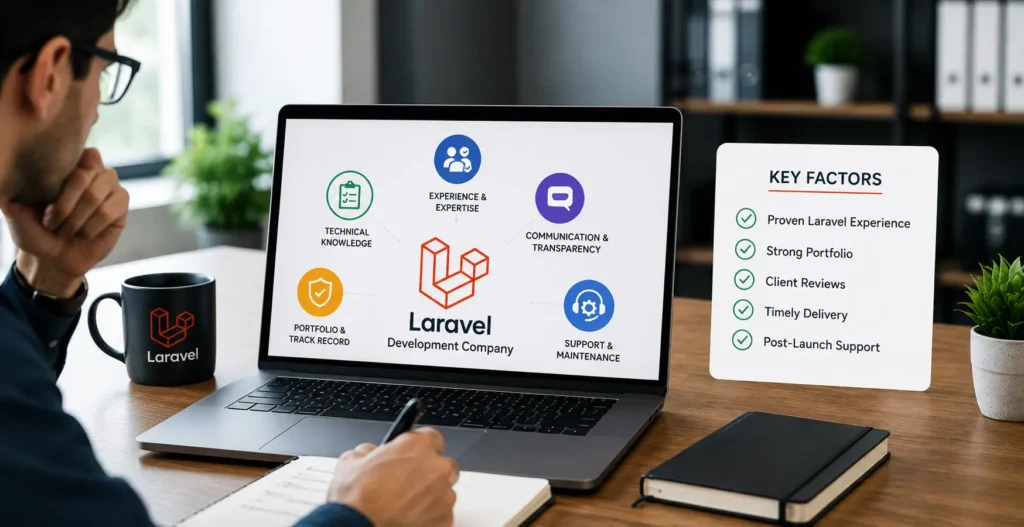
I have been on both sides of this. I have built Laravel applications since version 4, and I have also sat across the table from clients evaluating us, watching them ask good questions and, more often, watching them ask the wrong ones.
Here is the thing nobody tells you when you are[ **hiring a Laravel development company**](https://www.krishaweb.com/laravel-development/). The hard part is not finding companies. A search gives you fifty. The hard part is telling the difference between a team that will ship you a maintainable system and a team that will hand you a working demo that becomes a maintenance nightmare in eighteen months. Both look identical in the sales call. Both have nice portfolios. Both say yes to everything.
This guide is how to tell them apart. The proposal details that reveal the truth, the technical questions a non-technical buyer can still ask, the one reference question that matters more than all the others, and the real costs so you know when a quote is too good to be true. Written from the inside, by someone who has answered all of these questions from the other chair.
## First, Get Clear on What You Actually Need
Before you talk to a single company, write down three things. This sounds obvious. Almost nobody does it, and it is the reason so many projects go sideways.
#### What are you building?
Not “a web app.” A specific description: a multi-tenant SaaS platform, an API backend for a mobile app, a custom CRM, a legacy migration off old PHP. The clearer this is, the better the proposals you will get back.
#### What is your timeline and budget range?
You do not have to share the budget, but you need to know it, because it determines whether you are hiring a freelancer, an agency, or an enterprise specialist. Those are three different conversations.
#### Who owns this after launch?
If your plan is for the company to maintain it forever, that is a dependency. If you plan to bring it in-house eventually, the company needs to build and document it differently. Decide now.
With those three things written down, you can actually evaluate the responses you get instead of being dazzled by whoever has the slickest deck.
## Match the Company Tier to Your Project
Not every Laravel project needs an agency, and not every agency can handle every project. There are three tiers, and using the wrong one is expensive in both directions.
#### Freelancer
Right for a small, well-defined scope: a specific feature, a bug-heavy codebase that needs stabilizing, a short sprint. Cheaper, faster to engage. The risk is no backup if they disappear, no code review, and no one to cover when they are sick or busy. Fine for under roughly $50,000 with a clear spec, risky above it.
#### Development Company / Agency
Right for product development, SaaS platforms, and anything needing ongoing delivery. You get code review, backup resources, DevOps support, and institutional knowledge a freelancer cannot match. Costs more than a freelancer, costs less than a bad freelancer hire you have to redo. This is the right tier for most serious projects.
#### Enterprise-Tier Specialist
Right for regulated industries, complex compliance, or very large budgets where the cost of failure is enormous. Premium pricing, deep process, formal governance. Overkill for a standard SaaS build, essential for a fintech or healthcare platform handling sensitive data.
The mistake I see most: a company with a $150,000 complex build trying to save money with a single freelancer, then paying an agency more than the original budget to fix it a year later. Match the tier to the stakes.
***Additional read:***
[*Laravel Development Cost: Freelancer vs Agency vs In-House*](https://www.krishaweb.com/blog/laravel-development-cost-freelancer-vs-agency-vs-inhouse/)
[*Top Laravel Development Companies to Hire*](https://www.krishaweb.com/blog/top-laravel-development-companies-to-hire/)*.*
## How to Read a Laravel Proposal (the Part That Matters Is What Is Missing)
Most proposals look the same on the surface: a scope summary, a timeline, a price, and a list of technologies. The difference between a strong company and a weak one is almost always in what the proposal does not say. Here is what to look for.
#### Who actually writes and reviews the code?
Do not assume senior involvement just because you met a senior person in the sales call. Ask specifically: who makes the key technical decisions, are they involved daily or only at review level, and who will you actually talk to week to week. A common bait-and-switch is a senior lead in the pitch and junior developers doing all the real work unsupervised.
#### Is the scope specific or vague?
“Build admin dashboard” is a red flag. “Admin dashboard with user management, role-based permissions, analytics, bulk actions, and report export” is a real scope. Vague scope means change orders later, because everything you assumed was included was not.
#### Is there a testing strategy?
A proposal that does not mention testing is telling you they do not test, which means they are building technical debt into your project from day one. A good company describes what they test (feature tests, integration tests on critical flows) and is honest about what they do not.
#### Is there a deployment and rollback plan?
Ask how releases are made safe and what happens when a deployment needs to be reversed fast. If the answer is some version of “we push to production,” you are carrying operational risk that should be on the company’s side.
#### Is ownership clear?
The proposal should state plainly that the code and IP are yours. If that is not in writing, ask why.
A proposal missing these is not a cheaper proposal. It is an incomplete one, and the gaps become your problem during the build.
## The Technical Questions a Non-Technical Buyer Can Still Ask
You do not need to be a developer to separate a real Laravel team from a generic PHP shop. You just need to ask the right questions and listen to how they answer, not just what they say. Here are the ones that work.
#### “Which Laravel version do you write new projects on?”
The correct answer in 2026 is Laravel 13 (the current generation) on PHP 8.3 or 8.4. If they are starting new projects on old versions, they are writing you a future security and maintenance problem.
#### “How do you handle database migrations on a live system?”
A real team has a careful, specific answer about safe migrations on production data. A vague answer means they have either never done it carefully or have caused outages doing it badly.
#### “Have you used Prism for AI integration?”
Laravel 13 shipped Prism, the first-party package for connecting Laravel to AI models. A team at the current edge of the framework can answer this from real project experience. It is a good 2026 test of whether they are keeping up.
#### “Walk me through how you would architect [your specific problem].”
Describe your actual project and ask how they would build it. Listen for whether they ask clarifying questions (good) or immediately promise everything is easy (bad). Real engineers probe before they commit.
#### “What is your code review process before something reaches production?”
This is the single most revealing question I know. A company with a process describes it specifically: pull-request review, named reviewer roles, staging sign-off, automated tests passing before merge. A company without one says something vague about experienced developers checking their own work. A developer reviewing their own code is not a quality gate.
You are not grading the technical detail. You are listening for depth and honesty versus polish and promises.
***Additional read:***[ *Laravel 13 Key Features*](https://www.krishaweb.com/blog/laravel-13-key-features/)*.*
## Check the References (and Ask the One Question That Matters)
Every company will give you references, and every reference will be a happy client. So the goal is not to confirm they have happy clients. It is to learn what they are actually like to work with. Call two or three, and after the pleasantries, ask the question that cuts through everything:
#### “Would you hire them again?”
The pause before the answer tells you as much as the answer. A genuine, immediate “absolutely” is worth more than any case study. A hesitant “yes, but…” is the most useful thing you will hear in the whole evaluation, because the “but” is exactly the risk you are signing up for.
A few follow-ups worth asking: Did they hit the timeline they promised? How did they handle it when something went wrong, because something always does? Did the code stay maintainable after they left? That last one separates companies that build for the demo from companies that build for the long run.
#### Consider a Paid Test Project
If you are choosing between two strong candidates and cannot decide, this is the best money you can spend. Pay $2,000 to $5,000 for one well-defined feature before committing to a $100,000+ project.
A small paid test reveals everything the sales process hides: the actual code quality, how they communicate when they hit a problem, whether they hit the small deadline, and what their work is genuinely like to receive. It is far cheaper to learn a company is wrong for you on a $3,000 feature than on a six-figure build. Good companies are usually happy to do this, because they are confident in their work. A company that refuses a reasonable paid trial is telling you something.
## What It Actually Costs for Laravel Development in 2026
So you can recognize a quote that is too good to be true or needlessly expensive, here are the real 2026 market rates by region.
**US and Canadian agencies:** $100 to $200 per hour. Western Europe and Australia: $80 to $180. Eastern Europe: $50 to $90. India: $25 to $60, with senior-led engagements at the upper end.
**By project:** a simple API or web app runs $15,000 to $40,000. A custom business application runs $40,000 to $100,000. A SaaS or enterprise platform runs $100,000 to $280,000+. Maintenance retainers run 15 to 20% of build cost per year.
The dramatic regional difference is why so much Laravel development happens offshore. A $120,000 build with a US agency can cost $40,000 to $60,000 with an experienced India-based agency at comparable quality. If you are weighing that route, our guide on how to[ **hire Laravel developers**](https://www.krishaweb.com/hire-laravel-developer/) walks through it. The thing that matters is the rate paired with proven quality and communication, not the rate alone. A cheap team whose work needs redoing twice is the most expensive option there is.
##### Additional Read
- [How to Build a Multi-Tenant SaaS with Laravel: A Product Manager’s Step-by-Step Guide](https://www.krishaweb.com/blog/laravel-multi-tenant-saas/)
- [Laravel Development Services in 2026: What’s Included, What It Costs, and What AI Changes](https://www.krishaweb.com/blog/laravel-development-services-cost/)
- [How to Hire a Laravel Developer in 2026 [Full Guide]](https://www.krishaweb.com/blog/guide-to-hire-a-laravel-developer/)
## The Red Flags, in One Place
If you see these, slow down.
No testing experience or a vague answer about it. Cannot explain Eloquent relationships, the core of how Laravel handles data, and uses raw queries instead. No experience upgrading Laravel versions, which means they will struggle to maintain your project long-term. Cannot explain queue architecture, which any non-trivial Laravel app needs to scale. A senior lead in the pitch who vanishes after signing. A scope so vague it guarantees change orders. A quote dramatically below market with no explanation. Refusal to provide references or do a reasonable paid trial. No clarity on who owns the code.
Any one of these is a conversation. Several together is a decision.
### Frequently Asked Questions
**How do I choose the right Laravel development company?**Start by defining what you are building, your timeline and budget, and who owns the project after launch. Match the company tier to your project: freelancer for small, defined scope; agency for product development; and enterprise specialist for regulated or high-stakes work. Then evaluate proposals for specific scope, a testing strategy, a deployment plan, clear senior involvement, and code ownership. Ask technical questions about their Laravel version, code review process, and how they handle live migrations. Finally, check references with one question: “Would you hire them again?” and consider a small paid test project before committing.
**What questions should I ask a Laravel development company before hiring?**Ask which Laravel version they build new projects on (should be Laravel 13 on PHP 8.3+), how they handle database migrations on live systems, what their code review process is before production, whether they have used Prism for AI integration, and how they would architect your specific project. Listen for depth and honesty over polish. The most revealing question is about their quality gate between development and production; a real process is described specifically, while a weak one gets a vague answer about experienced developers checking their own work.
**How much does it cost to hire a Laravel development company in 2026?**Rates vary by region: US and Canada $100 to $200 per hour, Western Europe and Australia $80 to $180, Eastern Europe $50 to $90, and India $25 to $60. By project, a simple web app or API runs $15,000 to $40,000, a custom business application $40,000 to $100,000, and a SaaS or enterprise platform $100,000 to $280,000+. Maintenance retainers run 15 to 20% of build cost per year. A comparable build can cost two to three times more in the US than with an experienced India-based agency.
**Should I hire a freelancer or a Laravel development company?**Hire a freelancer for small, well-defined tasks under roughly $50,000 with a clear specification. Hire a Laravel development company for product development, SaaS platforms, or anything needing ongoing delivery, because you get code review, backup resources, DevOps support, and institutional knowledge a freelancer cannot provide. A freelancer is a single point of failure with no one to cover gaps. For business-critical or long-lived projects, the structure of a company is worth the higher cost.
**What is the difference between a PHP developer and a Laravel developer?**PHP is the language; Laravel is the framework built on it. A generic PHP developer may not know Eloquent (Laravel’s database layer), Blade (its templating), queues, or the wider Laravel ecosystem and conventions. Hiring someone who knows PHP but not Laravel specifically often results in code that does not use the framework properly, which is harder to maintain. For a Laravel project, prioritize framework-specific experience over general PHP skills.
**How do I know if a Laravel company is actually experienced or just listing it?**Ask three things. Which Laravel version do they build on? (Laravel 13 on PHP 8.3+ is current.) How do they handle multi-tenancy or live database migrations (a real answer is specific, a fake one is vague)? And have they used first-party Laravel tooling like Prism, Octane, or Horizon on real projects? Combine this with a portfolio of complex builds (not just marketing sites), publicly visible senior developers, and references who would hire them again. Framework knowledge alone is not enough; you want evidence of architecture maturity on projects like yours.
#### Talk to KrishaWeb About Your Laravel Project
I lead the custom development practice at KrishaWeb. We have built on Laravel since version 4, ship Laravel 13 projects with Prism AI integration, and run the kind of code review and staging process this guide tells you to look for. Named account managers in the US, Australia, and Europe. Fixed-price quotes. Code your own team can review and maintain.
If you are evaluating Laravel companies, put us through the questions in this guide. We would rather answer them honestly than win a project we are not right for. Tell us what you are building.[ **Schedule a call**](https://api.leadconnectorhq.com/widget/bookings/book-a-call-with-parth-krishaweb) to talk it through, or[ **contact us**](https://www.krishaweb.com/contact-us/) with your project details.

###### Nirav Panchal
Lead – Custom DevelopmentLead of the Custom Development team at KrishaWeb, holds AWS certification and excels as a Team Leader. Renowned for his expertise in Laravel and React development. With expertise in cloud solutions, he leads with innovation and technical excellence.
 Interact With Me-
-
- [ ](mailto:)
---
_View the original post at: [https://www.krishaweb.com/blog/how-to-choose-laravel-development-company/](https://www.krishaweb.com/blog/how-to-choose-laravel-development-company/)_
_Served as markdown by [Third Audience](https://github.com/third-audience) v3.6.1_
_Generated: 2026-06-26 10:54:11 UTC_