---
title: "White Label AI Development: Offer AI Services Without Building an AI Team"
url: "https://www.krishaweb.com/blog/white-label-ai-development-agencies/"
date: "2026-10-16T12:37:52+00:00"
modified: "2026-10-16T12:37:54+00:00"
type: "Article"
resource: "https://www.krishaweb.com/blog/white-label-ai-development-agencies/"
timestamp: "2026-10-16T12:37:54+00:00"
author:
name: "Nirav"
url: "https://www.krishaweb.com"
categories:
- "Web Development"
word_count: 2930
reading_time: "15 min read"
summary: "Right now, your clients are asking about AI, and if you can't answer, someone else will. That's the squeeze agencies are in: demand for AI agents, automations, and chatbots is everywhere, but hirin..."
description: "White label AI development lets agencies offer AI agents, automation and chatbots under their brand. See pricing, margins, risks and how to vet a partner."
keywords: "white label AI development, Web Development"
language: "en"
schema_type: "Article"
related_posts:
- title: "White Label Web Design: Delivering Design Work Under Your Agency’s Brand"
url: "https://www.krishaweb.com/blog/white-label-web-design-agencies-brand/"
- title: "White Label Digital Marketing: Reselling SEO, Content, and Paid Under Your Brand"
url: "https://www.krishaweb.com/blog/white-label-digital-marketing-reselling/"
- title: "White Label Web Development: What to Look For in a Reliable Partner"
url: "https://www.krishaweb.com/blog/white-label-web-development-reliable-partner/"
---
# White Label AI Development: Offer AI Services Without Building an AI Team
_Published: Friday,October 16, 2026_
_Author: Nirav_
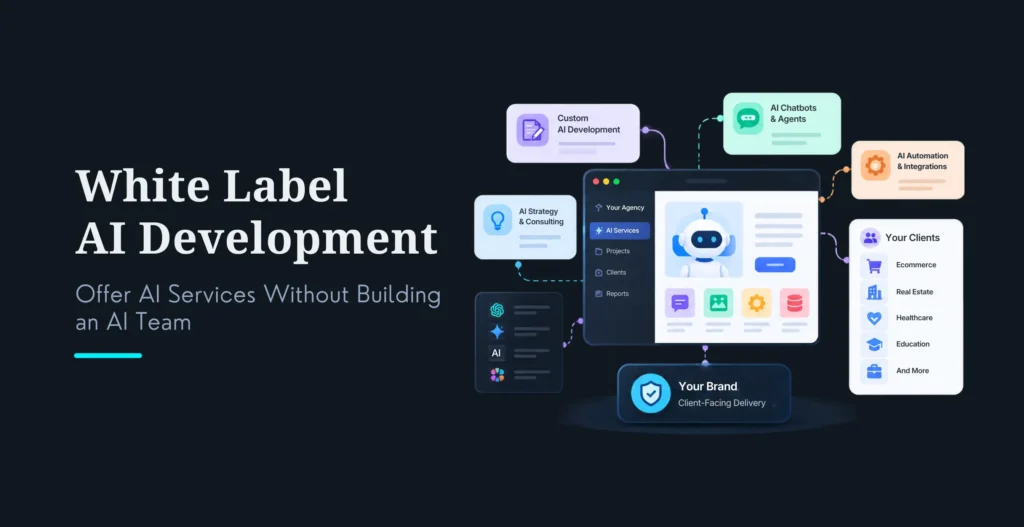
Right now, your clients are asking about AI, and if you can’t answer, someone else will. That’s the squeeze agencies are in: demand for AI agents, automations, and chatbots is everywhere, but hiring an AI engineer costs 150K–250K+ a year and takes months to land. White label AI development is how agencies close that gap, offering real AI services under their own brand without building an AI team at all.
White label AI development is an arrangement where you sell an AI project to your client under your own brand, and a specialist partner scopes, builds, tests, and maintains it behind the scenes. You own the client relationship and the commercial terms; the partner supplies the engineering (and, if they’re good, the governance). The client never sees them. It lets an agency meet AI demand immediately, without the cost, hiring risk, or ramp time of an in-house AI team, while keeping the relationship and the margin.
This guide covers what AI services you can actually resell, how the partner stays invisible, honest pricing and margins, the risks that are specific to AI (platform dependency, IP ownership, regulated data), and how to vet a partner. It’s written for the agency owner or ops lead whose clients want AI faster than they can hire for it. AI capability is fast becoming one of the **[bottlenecks that stall agency growth](https://www.krishaweb.com/blog/bottlenecks-that-stop-digital-agencies-from-scaling/)**, and this is the cleanest way to clear it, part of the broader **[shift AI is driving across web and agency work](https://www.krishaweb.com/blog/impact-of-ai-on-web-development/)**.
That’s the model behind our own **[white label AI and vibe-coding services](https://www.krishaweb.com/white-label-ai-vibe-coding-services/)**, fully branded to you, NDA-first, and this guide will help you hold any partner to that bar.
**Key Highlights**
- **What it is:** You sell an AI project under your brand; a specialist partner builds and maintains it invisibly. You keep the client and the margin; they supply the engineering.- **What you can resell:** AI agents, workflow automation, chatbots, analytics dashboards, knowledge bases (RAG), AI readiness audits, custom models, and more, essentially any AI build your clients need.- **Pricing:** Project builds commonly run a few thousand to $15,000+ depending on complexity; AI engineering time runs roughly 15–35/hour wholesale versus 100–250/hour retail. Treat specific figures as illustrative, not guaranteed.- **Margins:** Practitioners commonly report project builds in the 50-65% gross range, with retainers higher. No independent benchmark exists for AI, and net margin is lower once you count your own account-management and oversight time.- **The invisibility rule:** Your brand on every deliverable, your name on every call, the partner never contacts your client directly, backed by a written NDA and non-solicitation.- **The AI-specific risks to manage:** Platform dependency, weak IP and code ownership, and regulated-data handling, which ordinary white label rarely involves and all of which must be nailed in the contract.- **The bottom line:** White label AI lets you offer AI now instead of in a year, but vet the partner for real engineering depth, clean IP, and compliance, not just a slick demo.
## What White Label AI Development Is
White label AI development is a wholesale-to-retail arrangement for AI engineering. A specialist partner scopes and builds the AI solution at a wholesale rate; you, the reseller agency, add your markup and deliver it to the client under your own brand. You own the client relationship and pricing; the partner handles development, integration, and technical support, invisibly. It runs on three parties: the end client who needs the AI, the reseller agency (you) who owns the relationship, and the white label provider who builds it behind the scenes.
The workflow: you sell and close the AI project under your brand, brief the partner with the use case and data sources, they turn that into a technical scope, build it, test it, and maintain it (all under your brand), you quality-check and present it to the client as your own, and they handle ongoing support. Your job is strategy, sales, and client relationship; theirs is the AI engineering, the part most agencies can’t staff.
The appeal is specific to this moment: you meet surging client demand for AI without hiring scarce, expensive AI engineers, you create recurring revenue (AI retainers are sticky), and you can offer capabilities, custom agents, ML models, computer vision, that you’d never justify building in-house. For agencies already modernizing their own offering, it pairs naturally with the move toward **[AI-powered agency positioning](https://www.krishaweb.com/blog/ai-powered-agency-websites/)**.
## What AI Services You Can Resell
The menu is broad, which is part of what makes this category so useful, you can match almost any client AI request. The most commonly resold builds:
AI agents and chatbots, autonomous or conversational systems for lead qualification, customer support, internal help, or research. Workflow automation, AI wired into real processes like invoice handling, lead routing, data entry, and reporting. AI-powered analytics dashboards, data visualization with AI-generated insights. Enterprise knowledge bases, RAG-based search and Q&A over a client’s own documents. And AI readiness audits, the strategy-and-scoping work that often precedes a build (and is an easy, low-risk first sale).
Beyond those, the deeper engineering lines include custom AI model development and fine-tuning, machine learning model training, NLP, computer vision, voice and speech recognition, text analysis and summarization, product recommendation systems, predictive analytics, AI-powered CRM, custom AI APIs, and even full AI SaaS product development. Generative-media services (AI product photography, AI video) round out the list for agencies with creative clients. The practical takeaway: whatever AI a client asks for, a capable partner can likely build it under your brand, which means you can say “yes” to AI briefs you’d otherwise have to decline.
## How It Stays Invisible to Clients
This is the part agency owners scrutinize most, and with AI there’s an extra wrinkle: the work is technical and iterative, so there are more touchpoints where a partner could surface. Invisibility has to be designed in. Done right, the client experiences one team, yours, and never learns a partner exists.
The principle: the partner works through you, not around you. They don’t contact your client directly unless you’ve both explicitly agreed to a declared arrangement, they don’t put their name on the deliverable, and they route everything, updates, demos, documentation, through your team. From the client’s view, they’re buying an AI service from your agency, full stop.
What makes it hold in an AI engagement specifically: decide up front who attends discovery calls, who answers the client’s technical questions, and whose name appears in the places AI work lives, repositories, design files, documentation, demos, and support channels. If the partner must stay fully invisible, confirm that’s actually practical for every client-facing tool before work starts (a partner’s name surfacing in a Git repo or a dashboard footer is a common slip). Give access by role, remove it when the engagement ends, and back the whole thing with a written NDA and an explicit non-solicitation clause. The direct question to ask any partner: “Can you work entirely behind our brand, or do you require direct client access?” If they need direct access, that’s a constraint you must plan around, or a reason to look elsewhere.
## Pricing and Margins (Honestly)
AI pricing is less standardized than SEO or web design, so treat every figure here as an illustrative planning range and scope your own quotes, the numbers move fast and vary widely by complexity. Two framings are useful.
By engagement, project builds scale with complexity: a focused automation or chatbot might run a few thousand dollars wholesale, a custom AI agent build more, and a complex multi-system build or AI SaaS into five figures and up ($15,000+). Simpler white label AI automation can start around 1,000–1,200. By time, a commonly cited benchmark: AI engineering runs roughly 15–35/hour wholesale from offshore specialists, versus 100–250/hour at US/Western agency rates, which is where a large share of the margin lives. These figures come largely from provider sites, so verify them with real quotes. Retainer models (setup fee plus a monthly for maintenance, retraining, and reporting) are common and attractive because they’re recurring.
On margins, be careful with the eye-catching percentages circulating online. You’ll see specific claims like “57% on an agent build, 67% on a retainer,” those come from individual practitioner posts, not broad data, so use them as one illustration, not a benchmark. What practitioners commonly report is that white label AI project builds land in roughly the 50-65% gross-margin range, with retainers higher, because the wholesale-to-retail spread on specialist engineering is large. No independent benchmark exists for AI work, so treat that as an estimate. Two honest caveats decide whether that gross becomes real profit. First, AI projects are iterative and oversight-heavy, so your own time (scoping, reviewing outputs, managing client expectations, QA) is a real cost that pulls net margin well below gross. Second, scope ambiguity is acute with AI, “make it smarter” is not a spec, so unclear requirements quietly erode margin faster than in any other white label category. Price for the oversight, define scope tightly, and the margins are excellent; skip either and they evaporate.
## The Risks, and How to Manage Them (AI-Specific)
White label AI carries the usual white label risks, client poaching (counter with NDA plus non-solicitation and no direct contact), quality inconsistency (vet hard, run a paid pilot, review every output before it reaches the client), and communication breakdowns. But it also carries three risks that are specific to AI and that agencies routinely underestimate.
Platform dependency. If your partner, or the AI platform they build on, raises prices, changes an API, or sunsets a feature, you absorb the disruption with no buffer. Mitigate by choosing partners with flexible, portable architecture rather than lock-in, negotiating exit terms and data portability up front, and keeping a backup option for critical services. IP and code ownership. This is the big one, and it’s easy to get wrong: you can pay in full for an AI build and still not clearly own it. With AI there’s more to pin down than with ordinary code, who owns the prompts, the fine-tuned model weights, the training data pipeline, the outputs? Get clean IP transfer in writing, and spell out ownership of each of those components before signing. Regulated data. AI builds frequently touch sensitive data (health, financial, personal), and HIPAA, SOC 2, or GDPR obligations don’t disappear because a partner did the work, they’re still your client’s, and your reputation. Ask directly how a partner would handle a build touching regulated data, and only work with ones who have real compliance and data-governance practices.
One more, subtler risk: client expectation gaps. AI is over-hyped, and it’s tempting to oversell. Set realistic expectations, educate the client on what the AI can and can’t do, and define clear boundaries, an over-promised AI project that underdelivers damages your brand, not the invisible partner’s.
## Choosing a Partner, and When to Build Instead
Vet an AI partner harder than a design or dev partner, because the technical bar and the risk surface are both higher. The non-negotiables: a signed NDA and non-solicitation, demonstrable AI engineering depth (real builds, not just wrappers around someone else’s API), a documented QA process for reviewing AI outputs, clean IP transfer covering prompts, models, data, and outputs, compliance capability for regulated data, transparent pricing, full white-label branding with no direct client contact, agency references you can call, and a willingness to prove it on a paid pilot (a 30-day, realistic-usage test is ideal for AI). The questions that cut through: Which parts of discovery, build, and delivery can your team own? Can you work entirely behind our brand? How do you handle a build touching regulated data? Who owns the prompts, fine-tuned models, and data pipeline? And how do you handle platform dependency if an API changes? Walk away from anyone who won’t sign protections, is vague on IP, or can’t speak credibly to compliance, with AI, those gaps are expensive.
On whether to build in-house instead: white label wins decisively when you have AI demand but no AI engineers, when you want to offer AI now rather than in 6-12 months, when demand is variable, and when you want to test the AI market before committing to a 150K–250K+ hire. Build in-house only when AI is becoming the core of your agency’s identity, demand is steady and predictable enough to keep an expensive engineer busy, and you want to own that institutional knowledge long-term. For most agencies today, the right move is white label first, prove the demand and learn the market, then hire selectively once the economics are proven. To run the actual build-vs-partner numbers, our **[agency vs in-house cost](https://www.krishaweb.com/blog/ai-agency-vs-in-house-cost/)** breakdown does the math, and the vetting discipline a client uses when **[choosing an agency](https://www.krishaweb.com/blog/how-to-choose-web-design-agency/)** is the discipline to apply to your own AI partner.
##### Additional Read
- [White Label Web Design: Delivering Design Work Under Your Agency’s Brand](https://www.krishaweb.com/blog/white-label-web-design-agencies-brand/)
- [White Label Web Development: What to Look For in a Reliable Partner](https://www.krishaweb.com/blog/white-label-web-development-reliable-partner/)
- [White Label Digital Marketing: Reselling SEO, Content, and Paid Under Your Brand](https://www.krishaweb.com/blog/white-label-digital-marketing-reselling/)
### Frequently Asked Questions
**What is white label AI development?**It’s an arrangement where you sell an AI project to your client under your own brand while a specialist partner scopes, builds, tests, and maintains it behind the scenes. You own the client relationship and commercial terms; the partner supplies the AI engineering and stays invisible. It lets an agency offer real AI services, agents, automations, chatbots, custom models, without hiring an in-house AI team, meeting client demand for AI while avoiding the cost and ramp time of scarce AI engineers.
**How does white label AI development work?**You sell the AI project to your client under your brand, brief the partner with the use case and data sources, the partner turns that into a technical scope and builds, tests, and maintains it (all under your brand), you quality-check and present it as your own, and the partner provides ongoing support. You own strategy, pricing, and client communication; the partner owns the engineering. The client interacts only with you and never knows, or deals with, the fulfillment partner.
**What AI services can agencies resell?**Almost any AI build: AI agents and chatbots, workflow automation, AI-powered analytics dashboards, enterprise knowledge bases (RAG search and Q&A), AI readiness audits, custom AI model development and fine-tuning, machine learning training, NLP, computer vision, voice and speech recognition, text analysis, predictive analytics, recommendation systems, AI-powered CRM, custom AI APIs, AI-driven process automation, and even full AI SaaS products, plus generative-media services like AI product photography and video. If a client asks for it, a capable partner can usually build it under your brand.
**How does white label AI development stay invisible to clients?**The partner works through you, not around you: they don’t contact your client directly (unless you’ve both agreed otherwise), don’t put their name on deliverables, and route everything through your team. The client sees only your brand. With AI, you specifically have to decide up front whose name appears in repositories, dashboards, documentation, demos, and support channels, and confirm full invisibility is practical for every client-facing tool before work starts. Back it with a written NDA and non-solicitation, and give the partner access by role, removed when the engagement ends.
**How much does white label AI development cost, and what can I charge?**It varies widely by complexity, treat figures as planning ranges. Simpler automations or chatbots can start around 1,000–1,200 wholesale; custom AI agent builds and multi-system projects run into five figures ($15,000+). By time, AI engineering runs roughly 15–35/hour wholesale versus 100–250/hour at US/Western agency rates, which is where much of the margin sits. Retainers (a setup fee plus monthly maintenance and retraining) are common and recurring. Scope tightly and get a real quote, AI pricing isn’t standardized.
**What margin can agencies realistically make on white label AI?**Practitioners commonly report gross margins on project builds of roughly 50-65%, with retainers higher, because the wholesale-to-retail spread on specialist AI engineering is large. No independent benchmark exists for AI work, and precise viral figures like “57%” or “67%” come from individual posts, so treat them as illustrations. The honest caveat: AI projects are iterative and oversight-heavy, so your own scoping, review, and client-management time pulls net margin below gross. Price for that oversight and define scope tightly, or the margin erodes.
**What risks are specific to white label AI (vs ordinary white label)?**Three. Platform dependency: if a partner or AI platform raises prices, changes an API, or sunsets a feature, you absorb it, mitigate with portable architecture, exit terms, and a backup. IP and code ownership: with AI you must explicitly nail ownership of prompts, fine-tuned models, data pipelines, and outputs, not just “the code,” get it in writing. Regulated data: HIPAA, SOC 2, and GDPR obligations remain yours and your client’s, so only use partners with real compliance practices. Plus the usual: client poaching, quality control, and over-promising what AI can do.
**Should I use white label AI or build an in-house AI team?**White label wins when you have AI demand but no AI engineers, want to offer AI now rather than in 6-12 months, have variable demand, or want to test the AI market before a 150K–250K+ hire, which describes most agencies today. Build in-house only when AI is becoming core to your identity, demand is steady enough to keep an expensive engineer busy, and you want to own the institutional knowledge. The smart sequence is white label first, prove the demand, then hire selectively once the economics are clear.
### Conclusion
AI demand has arrived faster than most agencies can hire for it, and that gap is exactly the opportunity. White label AI development lets you say “yes” to the AI briefs landing in your inbox, agents, automations, chatbots, dashboards, under your own brand, without the cost, risk, or year-long ramp of building an AI team. You keep the client, the brand, and the margin; a specialist supplies the engineering invisibly.
The model rewards clarity on three things, and two of them are unique to AI. Invisibility: your brand on everything, no direct client contact, NDA and non-solicitation in writing, and a deliberate plan for whose name appears in the technical tools. The AI-specific risks: nail down IP ownership of prompts, models, and data pipelines, confirm compliance capability for regulated data, and avoid platform lock-in. And the margin math: the spread is large, but price for the oversight AI projects demand and scope tightly, because “make it smarter” is where margins go to die. Get those right and white label AI is the highest-differentiation growth move available to an agency right now. Get them wrong and it’s a reputation and legal risk wearing a margin disguise. Vet the partner as carefully as you’d vet the AI engineer you’re choosing not to hire, because that’s exactly the decision.
##### Ready to offer AI services without building an AI team?
**[Explore our White Label AI & Vibe-Coding Services](https://www.krishaweb.com/white-label-ai-vibe-coding-services/)** to see how we build AI agents, automations, and chatbots under your brand, fully white-labeled, with NDA and clean IP transfer standard.
**[Book a consultation](https://www.krishaweb.com/contact-us/)** to talk through the AI work your clients are asking for and start with a scoped paid pilot.

###### Nirav Panchal
Lead – Custom DevelopmentLead of the Custom Development team at KrishaWeb, holds AWS certification and excels as a Team Leader. Renowned for his expertise in Laravel and React development. With expertise in cloud solutions, he leads with innovation and technical excellence.
 Interact With Me- [ ](https://twitter.com/iamNiravPanchal)
- [ ](https://www.linkedin.com/in/nirav-panchal-5b299385/)
- [ ](mailto:niravp@krishaweb.com)
---
_View the original post at: [https://www.krishaweb.com/blog/white-label-ai-development-agencies/](https://www.krishaweb.com/blog/white-label-ai-development-agencies/)_
_Served as markdown by [Third Audience](https://github.com/third-audience) v3.6.1_
_Generated: 2026-10-16 12:37:54 UTC_