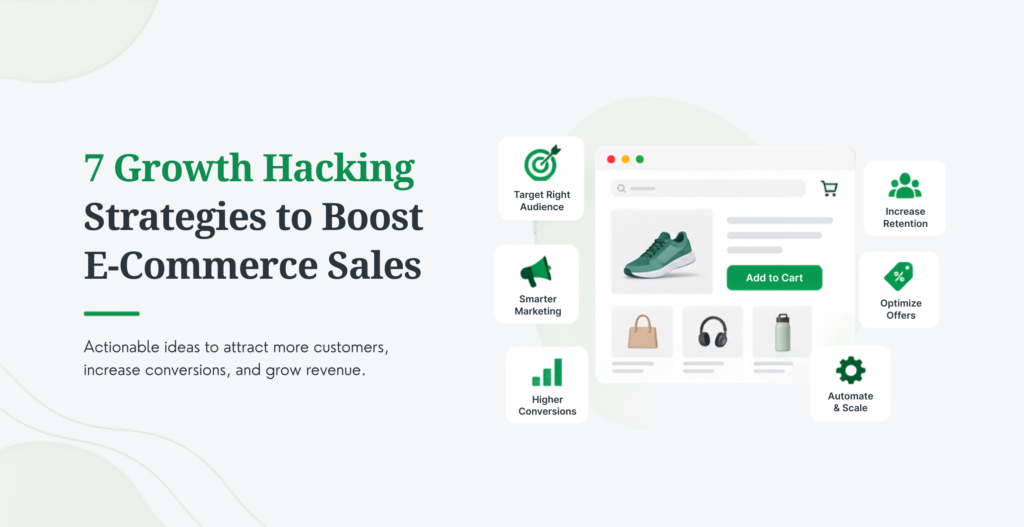
E-commerce reached 16.9% of total US retail sales in the first quarter of 2026, according to the US Census Bureau, up from 15.9% a year earlier. That growth means more competition for every sale, not less, since a bigger slice of retail spending draws more stores chasing it. Growth hacking for e-commerce means finding data-driven, testable tactics that move revenue fast, not running every marketing idea at once and hoping something sticks. Below are 7 strategies worth putting to work this week, each one upgraded from what worked a few years ago to what works now.
Why Growth Hacking Matters for E-Commerce Right Now
Customer acquisition costs keep climbing as ad platforms get more crowded and more expensive per click. That shift alone makes retention, lifetime value, and personalization matter more than they did even two years ago, since keeping a customer costs far less than winning a new one through paid ads.
The end of easy third-party cookie tracking has pushed first-party data, quizzes, preference centers, loyalty programs, into the center of any real growth strategy rather than a nice-to-have. AI and automation now handle a lot of the personalization and testing work that used to require a full team, which is part of why growth hacking today moves faster and tests more variables than it did in 2019.
Strategy 1: Build Instant Trust and Credibility
Every consumer looks for reliability before handing over payment information to a store they haven’t bought from before. Security badges, visible SSL indicators, and recognizable payment logos (Visa, Mastercard, PayPal, Apple Pay) all reduce hesitation at checkout. A clear return and refund policy, visible shipping information, and real contact details do the same work in a different form.
Display security badges and trusted payment logos near the checkout button, not just in the footer
State the return and refund policy plainly on product pages, not buried in a separate terms page
Use real customer photos and video testimonials instead of stock imagery
Add “verified buyer” tags to reviews so visitors know the feedback is real
Show live order notifications (“Someone in Austin just bought this”) where genuine, since fabricated ones damage trust once noticed
Strategy 2: Focus on Retention Over Pure Acquisition
Bain & Company’s widely cited research found that increasing customer retention by just 5% can increase profits by 25% to 95%, depending on the industry. Returning customers also tend to spend more per visit and convert at a meaningfully higher rate than first-time visitors, since trust is already established.
Build a loyalty program with points, tiers, or VIP perks that reward repeat purchases
Set up post-purchase email and SMS flows: a thank-you message, a relevant cross-sell, a review request
Run win-back campaigns targeting customers who haven’t purchased in 60 to 90 days
Offer a subscribe-and-save option for consumable or repeat-purchase products
Segmenting customers by behavior, high spenders, one-time buyers, at-risk accounts, makes each of these tactics sharper. Our guide to using analytics to improve website UX covers how to set up the tracking this segmentation depends on.
Strategy 3: Use Real Customer Photos and Reviews
Reviews and testimonials from real people build more trust than a business talking about itself, but not all reviews carry equal weight. A review attached to a real name and photo reads as more credible than an anonymous one, and asking customers to share photos using the product after purchase turns satisfied buyers into a steady stream of content.
Incentivize photo and video reviews with a small discount or loyalty points
Feature user-generated content on product pages, not just a separate reviews tab
Pull short-form video content (Reels, TikTok, Shorts) into product pages where relevant
Consider micro-influencer collaborations for categories where peer recommendation carries extra weight
Strategy 4: Use High-Converting Product Videos and Demos
Product videos, unboxings, how-to demonstrations, before-and-afters, consistently outperform static images for both engagement and conversion. The format matters as much as the content now: short, vertical video built for mobile viewing, with captions since most viewers watch with sound off.
Place demo videos directly in the product image gallery, not just linked from a separate page
Add captions or subtitles to every video for sound-off viewing
Use shoppable video elements where the platform supports them, letting viewers click directly on a featured product
Track video engagement against conversion rate and return rate, not just view count
Strategy 5: Design Data-Driven Offers, Not Just Discounts
Every shopper responds to a good deal, but constant blanket discounting trains customers to wait for a sale instead of buying at full price. The stronger approach uses data to decide which products, which customer segments, and which timing need an incentive.
Offer a first-purchase discount or free shipping threshold to reduce first-order hesitation
Build bundles and BOGO offers around products that are already frequently bought together
Use cart-abandonment offers triggered by real abandonment behavior, not a blanket weekly discount
Send personalized offers tied to a birthday, anniversary, or VIP status rather than storewide sales
AI-driven dynamic pricing and personalized coupon generation have made this kind of targeting far more accessible than it was a few years ago, when this level of segmentation required a dedicated analytics team to execute manually.
Strategy 6: Highlight Best Sellers and Smart Recommendations
Not every visitor arrives with a clear idea of what they want. “Best Sellers,” “Trending Now,” and “Customers Also Viewed” sections give undecided shoppers direction, and AI recommendation engines now personalize these sections per visitor rather than showing the same list to everyone. McKinsey’s research on personalization ties this kind of targeting to a 10 to 15% revenue lift for companies that do it well. Our e-commerce conversion rate optimization guide covers how to set this up without a full platform rebuild.
Add a homepage section for best sellers or trending products, updated automatically rather than manually
Personalize product recommendations based on browsing and purchase history where the platform supports it
Show social proof directly in these sections (“40 people bought this in the last week”), only when the number is real
Strategy 7: Maximize Seasonal and Holiday Campaigns
Consumers spend more freely during major shopping periods, and a store that treats every holiday the same way is leaving revenue on the table. Building a promo calendar in advance, rather than reacting the week of a sale, makes every seasonal push more effective.
Plan pre-holiday tactics: wishlists, early-bird access, VIP previews for loyal customers
Use during-holiday tactics: countdown timers and limited-stock alerts, only when accurate
Prepare post-holiday flows: easy returns and exchanges, gift card reminder campaigns, a January reset offer
Coordinate across channels: email, SMS, push notifications, and retargeting ads should all reflect the same campaign, not run in isolation
Bonus Growth Levers Worth Testing
A few additional tactics didn’t fit neatly into the 7 strategies above but are worth testing on their own. AI chatbots now handle guided selling conversationally, answering product questions and narrowing choices the way a good in-store associate would. First-party data strategies, quizzes, preference centers, matter more in a cookieless environment where third-party tracking keeps getting harder to rely on. Our piece on digital transformation with AI covers how these pieces fit into a broader technology roadmap.
Build a private community or loyalty group for your most engaged customers
Run a micro-influencer or affiliate program tied to performance, not flat sponsorship fees
Keep mobile speed and Core Web Vitals in the mix too, since a slow site undercuts every other strategy on this list before a visitor even sees the offer. Our AI-driven design decisions guide goes deeper on where performance and design intersect.
How to Implement These Strategies
Audit your current store: trust signals, offers, content, and retention flows
Pick 2 to 3 strategies to implement first, based on your biggest visible gaps
Set clear KPIs before starting: conversion rate, average order value, repeat purchase rate, email revenue share
Test, measure, and iterate: A/B test offers, creative, and flows rather than changing everything at once
Document what works and scale it before moving to the next strategy
Turning These Strategies Into Compounding Growth
None of these 7 strategies work in isolation as well as they do together. Trust gets someone to buy once. Retention, UGC, and smart offers are what turn that first purchase into a habit. If you want a closer look at how UX and conversion work together, our roundup of UX website examples built for conversion shows what strong execution looks like in practice.
Ready to put these strategies to work on your own store? Contact KrishaWeb for a growth audit, and we’ll help you prioritize the 2 or 3 changes that will move revenue fastest for your specific store.
Frequently Asked Questions
What is growth hacking in e-commerce?
Growth hacking in e-commerce means using fast, data-driven, testable tactics to grow revenue, rather than running broad campaigns and waiting weeks to see results. It prioritizes measurable experiments over guesswork, and doubles down quickly on whatever the data shows is working.
Which growth hacking strategy works best for small e-commerce stores?
Trust signals and retention tactics tend to deliver the fastest return for small stores, since both cost little to implement and directly affect conversion and repeat purchase rate. Video production and large seasonal campaigns usually make more sense once a store has more budget and traffic to work with.
How can I increase e-commerce sales without heavy ad spend?
Focus on retention, referrals, and user-generated content first. A loyalty program, post-purchase email flows, and encouraging customer photos all grow revenue from an audience you already have, without paying for new traffic through ads.
Does customer retention really matter more than acquisition?
For most stores, yes, especially once acquisition costs rise. A returning customer typically converts at a higher rate and spends more per order than a first-time visitor, and Bain & Company’s research ties even small retention improvements to substantial profit gains. Acquisition still matters, but retention is usually the more efficient lever.
What tools can I use for e-commerce growth hacking?
Email and SMS automation platforms handle retention flows, a review and UGC platform manages social proof collection, and most modern e-commerce platforms now include built-in AI recommendation and personalization tools. The right stack depends more on your platform (Shopify, WooCommerce, and others each have their own ecosystem) than on any single universal tool.
Ready to Scale Your Agency?
Tell us what you are trying to deliver. Schedule a call to talk it through, or contact us with your project.
Founder & CEO of KrishaWeb, leads an Enterprise Web Agency. With contributions to WordPress and organization of WordCamps, he pioneers innovation and community engagement in the digital realm.




 KrishaLabs
 KrishaStudio
 KrishaStore